
On 19‑December‑2025, the Employees’ Provident Fund Organisation (EPFO) issued an important circular titled “Rectification of Erroneous EPS Contributions” (Circular No. WSU/2025/E‑961539). This circular lays down a uniform framework to correct mistakes in Employees’ Pension Scheme (EPS) contribution records a long‑standing issue that has caused pension delays, claim rejections, and complications for many employees.
Before we dive into the specifics of the circular, it’s crucial to understand the eligibility criteria for EPS membership, especially since the rules were updated significantly in September 2014. This foundational understanding is essential for knowing when and why these errors occur and how the new guidelines will help resolve them.
What Makes You Eligible for EPS and What Changed in 2014
Basic EPS Eligibility (Post‑2014 Rules)
The Employees’ Pension Scheme (EPS) is available to employees covered under the Employees’ Provident Fund (EPF) scheme. However, not everyone qualifies automatically. The eligibility rules were changed significantly in September 2014 to raise the wage ceiling and set the age limit for EPS eligibility.
- Age Criterion: To qualify for EPS, an employee must join the EPF scheme before the age of 58. If an employee joins after 58, EPS membership is not applicable.
- Wage Ceiling: The ₹15,000 monthly wage ceiling for EPS contributions was introduced in September 2014. Before this, all employees were eligible for EPS. However, with the wage ceiling increase, employees who join after 1st September 2014 with wages exceeding ₹15,000 per month are no longer eligible for EPS. They can only contribute to EPF.
This means that employees who joined EPF before 01 September 2014 could be eligible for EPS even if their wages were higher than ₹15,000, while those who joined after that date with a wage above ₹15,000 are excluded from EPS membership by default.
Common Situations Where EPS Correction Helps
- Wrong EPS contribution despite ineligibility
- Missed EPS contributions for eligible employees
- Mismatched service history affecting pension claims
- Transfer or withdrawal issues due to incorrect EPS records
Not sure if you’re facing EPS issues? Get a free EPS audit to spot problems and avoid delays or rejections.
Before making any claims or transfers, it’s important to fix any EPS issues first.
Why This Circular Was Issue
EPFO has been facing frequent instances where:
- EPS contributions were wrongly remitted for employees ineligible for the pension scheme.
- EPS contributions were not deposited for employees who should have had them remitted.
This inconsistency has led to errors in:
- EPF passbooks,
- Service history records,
- Pensionable service calculation,
- Pension claims rejection or delays.
To address this, the EPFO has now prescribed standard corrective procedures that all field offices must follow uniformly.
Understanding the Two Main Error Scenarios
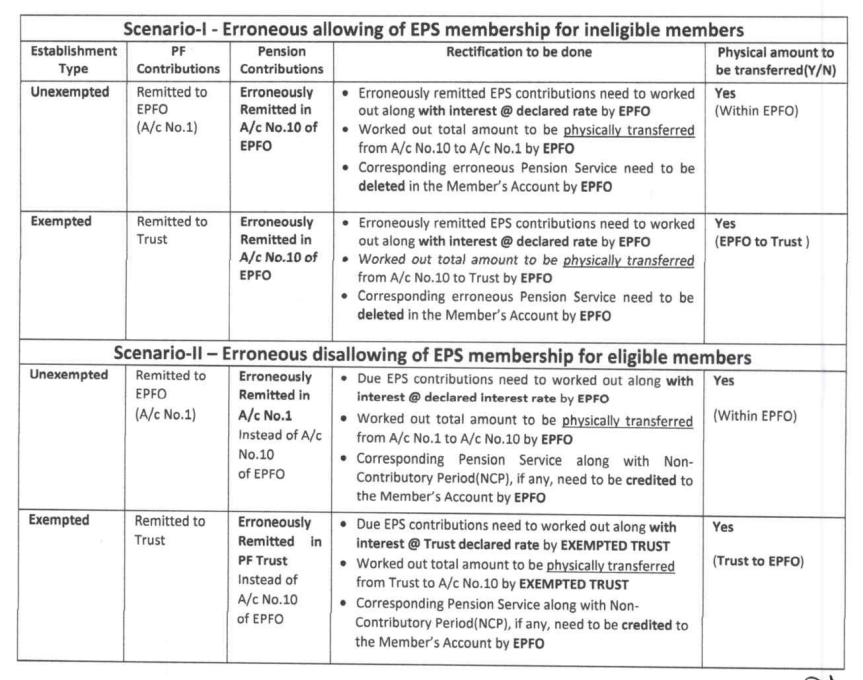
The circular tackles two core erroneous situations and instructs EPFO on how to correct each one.
✅ Scenario I: EPS Paid for Ineligible Members
This happens when:
- EPS contributions were made even though a worker was not eligible under EPS rules (as mentioned above).
- The employer mistakenly deposited funds into Account No. 10 (EPS account).
Rectification Steps:
- EPFO calculates erroneous EPS amount + interest at the declared interest rate.
- The amount is transferred:
- From Account No. 10 → Account No. 1 (for unexempted establishments),
- From Account No. 10 → PF Trust (for exempted establishments).
- Delete the incorrect pension service recorded in the member’s account.
✅ Scenario II: EPS Not Remitted for Eligible Members
This occurs when:
- Employers failed to remit EPS for members who were legally eligible,
- Contributions ended up in the Provident Fund (Account No. 1) instead of EPS.
Rectification Steps:
- EPFO calculates due EPS amount + interest.
- The funds are transferred:
- Update pensionable service and Non‑Contributory Period (if any) in the member’s record.
What Doesn’t Change: Employer’s Role
Some employees mistakenly think this circular lets EPFO fix things automatically. That’s not true.
EPFO will process corrections only after issues are identified and documented properly.
- Employers still must initiate or support the corrections by:
- Filing revised forms/returns,
- Issuing clarification letters,
- Submitting corrected contribution details,
- Coordinating with EPFO field offices.
In short: This circular does not relieve the employer from responsibility. Employers are still expected to initiate corrections and comply with procedural requirements. The EPFO circular only standardizes how the field offices will handle those corrections.
When These Issues Typically Arise
These EPS errors commonly occur due to:
- Incorrect payroll remittances: Wrong ECR uploads or misclassification of EPS vs EPF contributions.
- Ineligible retirement age or wage threshold mistakes.
- Failure to apply updated ECR validations.
- Transitions between employers where service/wage data wasn’t mapped correctly.
- Data entry errors at establishment level.
These mistakes usually surface when employees try to:
- Claim pension (Form 10D),
- Transfer EPF,
- Or when they check their EPF/EPS passbook and find missing or wrong EPS entries often leading to claim rejection reasons such as “EPS contributions not deposited”.
Common Challenges Employees Face
Employees can get stuck in loops like:
- Pension claim rejected due to EPS not credited,
- Employer either unaware or delaying correction,
- EPFO asking for documents repeatedly
- Incorrect service data blocking claims.
These loops happen not because EPFO can’t fix the error, but because the employer did not submit necessary correction documents or initiate the process properly.
How to Avoid Being Stuck in This Loop
Step‑by‑Step Preventive Actions
- Check your EPF/EPS Passbook regularly look at Account No. 10 entries.
- If EPS is missing or wrong, immediately notify your HR/Payroll team with proof.
- Ask your employer to file revised EPS returns or corrections with Digitally Signed Certificates (DSC).
- Keep copies of all communication and case IDs issued by EPFO.
- Follow up with the EPFO field office if corrections are delayed beyond reasonable timelines.
(Standard processing can take weeks to months depending on case complexity.)
Practical Tips / Care to Be Taken
✔ Ensure correct salary and wage reporting this affects your EPS contribution percentage.
✔ Track your service history and EPS wages via the member portal.
✔ Employers must file revised or supplementary returns when mistakes are spotted.
✔ Always get acknowledgement from EPFO when a correction request is processed.
✔ Don’t file pension claims until EPS corrections are reflected early filing leads to rejections and delays.
What This Guide Should Help You Do
This blog should empower you to:
- Understand EPFO’s new EPS correction circular and scenarios covered.
- Know exactly when and how errors are fixed.
- Recognise that employers must still initiate corrections.
- Avoid the frustrating loops of repeated rejections.
- Proactively ensure your EPS records are clean before claiming pension.
At FinRight, we specialize in resolving EPS correction issues, handling half of our cases involving complex EPS challenges. With in-depth expertise and a proven track record, we guide our clients through the EPS correction process from start to finish, ensuring your case is resolved swiftly and accurately. Don’t let EPS errors hold up your pension or claims any longer. Get the experts at FinRight on your side today and experience a seamless, hassle-free resolution.
Facing EPS Issues? We’re Here to Help!
Don’t let EPS mistakes hold up your hard-earned money. Get in touch with FinRight for a smooth and easy solution.
✔ Timely updates on your case progress
✔ Fixed fees with no surprises
✔ Zero-risk success guarantee
✔ End-to-end support from our expert team