The Employees’ Provident Fund Organization (EPFO), under the leadership of Dr. Mansukh Mandaviya, has announced several groundbreaking reforms aimed at streamlining PF services for Non-Resident Indians (NRIs). With a vision to ensure social security protection for Indian workers abroad, these reforms are set to transform the way NRIs access their PF benefits.
Here’s a quick breakdown of the major changes affecting NRIs:
1. Ensuring Social Security for Indian Workers Abroad
Dr. Mandaviya emphasized that India’s Free Trade Agreements (FTAs), including agreements like the India-UK FTA, will now incorporate social security protection provisions. This will ensure that Indian workers employed abroad will be able to retain their Provident Fund (PF) contributions and access benefits even after they return to India.
This is a huge win for NRIs, as it guarantees that EPF contributions made during their employment abroad will remain intact and can be easily accessed upon their return to India, without any complications or mismatches.
2. Streamlined Access for NRIs: Introducing Suvidha Providers
To further assist NRIs, the government will introduce EPF Suvidha Providers authorized facilitators who will act as a bridge between citizens and EPFO. These providers will guide NRIs through the EPF claims process, making it easier for them to access their PF balances, resolve issues, and ensure they receive the benefits they are entitled to.
For NRIs, this is a game-changer as it will provide them with personalized assistance and ensure that no bureaucratic barriers stand in the way of getting their PF benefits, no matter where they are in the world.
3. International Coverage Under EPFO
Under the new system, NRIs will also benefit from India’s increased social security coverage. Currently, more than 94 crore Indians are covered under social security, and this number is expected to rise to 100 crore by March 2026. This expanded coverage will ensure that NRIs can continue to enjoy social security protection even if they return to India after working abroad.
4. The Role of EPFO in Supporting NRI Workers
Dr. Mandaviya also highlighted the key role EPFO plays in safeguarding the hard-earned savings of workers, both domestic and international. He noted that the EPFO corpus now stands at a massive ₹28 lakh crore, providing 8.25% annual interest. For NRIs, knowing that their funds are safe with EPFO, backed by the Government of India, will bring peace of mind.
Key EPFO Reforms Affecting NRIs in 2026
The latest reforms focus on digitizing services and simplifying rules, making it easier for members to manage and withdraw their funds.
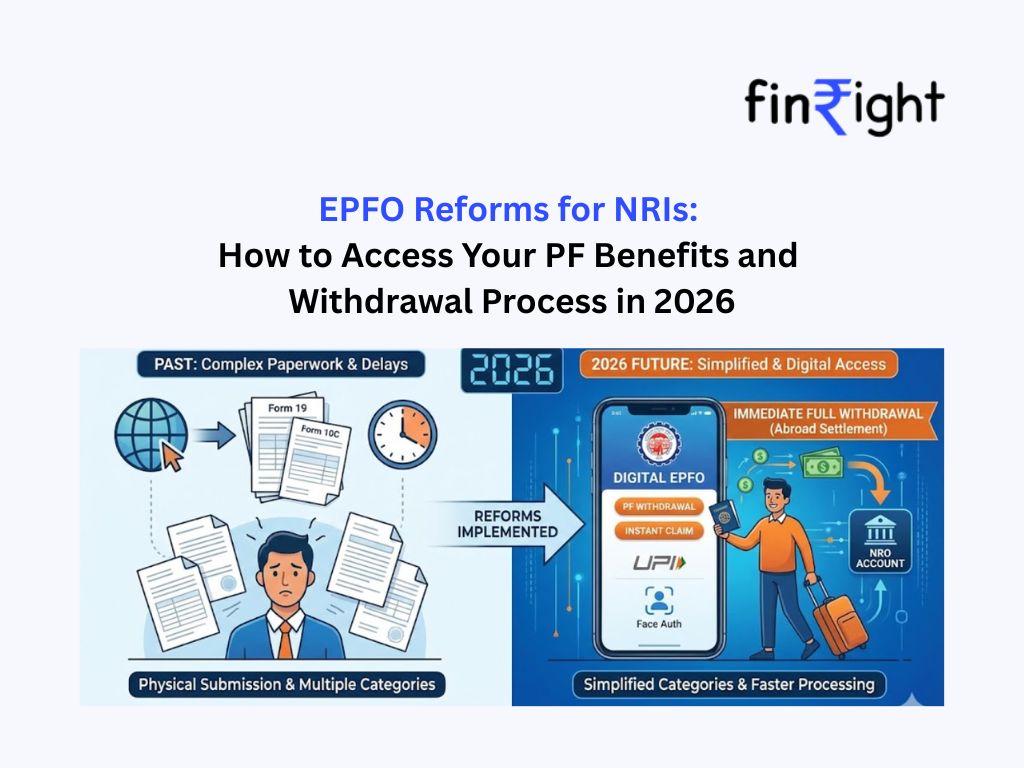
- Immediate Full Withdrawal for Resettlement Abroad: A primary benefit for NRIs is the ability to withdraw their entire EPF balance immediately upon permanent relocation to another country. You no longer need to wait for a specific period after leaving your job, provided your reason for exit is clearly marked as “Abroad Settlement” or “Permanent Settlement Abroad” in the EPFO records.
- Simplified Withdrawal Categories: The previous 13 separate withdrawal grounds have been consolidated into three broad categories: Essential Needs, Housing Needs, and Special Circumstances. This simplifies the application process.
- Faster Processing via Digital Channels: The introduction of “EPFO 3.0” aims to enable instant claim settlements and withdrawals through platforms like UPI, significantly reducing processing times.
- Simplified KYC and UAN Management: Members can now update their bank account details directly without needing employer approval and can generate or activate their Universal Account Number (UAN) using face authentication technology.
Want to Know if Going Abroad Can Block Your PF?
Do a quick 5-minute check on your PF to find out!
Get instant insights into your EPF balance, withdrawability, and any potential issues all in minutes!
✔ Real-Time Detection
✔ Immediate Withdrawable Amount
✔ End-to-End Data Protection
✔ 2-Factor Authentication for secure access
Step-by-Step PF Withdrawal Process for NRIs
The process can be completed either online or offline, depending on whether your Aadhaar is linked to your UAN.
Prerequisites Before You Apply
Before initiating the claim, ensure the following:
- UAN is Active: Your Universal Account Number must be active.
- KYC is Updated: Your PAN and Aadhaar details must be linked and verified in the EPFO portal.
- Bank Account: You must have an active Indian bank account, preferably an NRO account, linked to your UAN. EPFO does not credit funds to foreign bank accounts, and credits to NRE accounts can face restrictions.
- Correct Exit Date & Reason: Your former employer must have updated your “Date of Exit” and marked the reason as “Abroad Settlement” or “Permanent Settlement Abroad”. This is crucial for a full and immediate withdrawal.
Method 1: Online Withdrawal (Faster & Recommended)
This method is available if your UAN is linked with Aadhaar and your mobile number is connected to it.
- Log In: Visit the EPFO Member e-Sewa portal or use the UMANG app and log in with your UAN and password.
- Navigate to Claim: Go to the “Online Services” menu and select “Claim (Form-31, 19, 10C & 10D)”.
- Verify Bank Details: Enter the last four digits of your linked bank account number and verify it.
- Select Claim Forms:
- Choose “Only PF Withdrawal (Form 19)” for final settlement of your provident fund balance.
- Choose “Only Pension Withdrawal (Form 10C)” to withdraw your pension fund benefit.
- Specify Reason: Ensure the reason for exit is selected as “Abroad Settlement”.
- Upload Documents: You may be asked to upload scanned copies of your passport and visa to establish your NRI status.
- Authenticate and Submit: Authenticate the claim using an Aadhaar-based OTP sent to your registered mobile number to complete the submission.
Method 2: Offline Withdrawal
Use this method if your Aadhaar is not linked to your UAN.
- Download Form: Download the “Composite Claim Form (Non-Aadhaar)” from the EPFO website.
- Fill Details: Complete the form, ensuring you mark the reason for leaving as “Permanent Settlement Abroad”.
- Attestation: The form must be attested by one of the following:
- Your previous employer.
- A manager of the bank where you hold your account.
- An authorized official at the nearest Indian Embassy or Consulate in your country of residence.
- Attach Documents: Attach self-attested copies of your PAN card, passport, and a canceled cheque for your NRO bank account.
- Submit by Post: Send the completed form and documents via registered post to the respective EPFO regional office in India.
Important Considerations for NRIs
Inoperative Accounts: If you do not withdraw your funds after leaving employment, interest will continue to accrue on your account until you reach 58 years of age, after which it becomes an “inoperative account”.
Tax Implications (TDS): If you withdraw your PF balance before completing five years of continuous service, the amount is subject to Tax Deducted at Source (TDS). NRIs cannot submit Form 15G/15H to avoid TDS. Instead, you must apply for a lower or nil TDS certificate from the Income Tax Department. After five years of continuous service, the withdrawal is generally tax-exempt in India.
International Workers from Non-SSA Countries: For International Workers from countries with which India does not have a Social Security Agreement (SSA), the full PF balance can be withdrawn on retirement from service after attaining the age of 58.
What Does This Mean for NRIs?
The upcoming EPFO reforms are a significant step forward in ensuring that Indian workers abroad are not only protected but also have access to their PF benefits easily and quickly. By incorporating social security into international agreements and introducing Suvidha Providers, the government is addressing long-standing issues that NRIs have faced in accessing their EPF.
Whether you are currently working abroad or planning to return to India in the future, these changes will ensure that your PF contributions are preserved, accessible, and secure.
What Is Clear vs. What’s Still Pending
What is confirmed (Government intent)
- EPFO reforms will incorporate social security protections for Indian workers abroad into India’s FTAs.
- This signals that NRIs will likely receive better access to PF benefits after return.
- The reform was officially announced by the government during a public event and published by the Press Information Bureau.
What is not yet clarified
- No official date has been specified for when this rule will be legally enforced.
- Detailed operational guidelines for how NRIs can claim under FTA provisions have not been issued.
- There is no official EPFO circular or gazette notification detailing the implementation steps or timelines for these FTA social security provisions.
This means many parts of this reform especially how it will function for an individual PF account and when NRIs can start using it remain subject to future announcements from EPFO or the Ministry
How to Get Started
If you are an NRI who has been contributing to EPF while working abroad, here’s how you can take advantage of these reforms:
- Keep your EPF records updated: Ensure that your PF account is linked to your UAN and your KYC is complete.
- Stay updated on the Suvidha Providers: Keep an eye out for the introduction of Suvidha Providers in your region for direct assistance.
- Use the EPFO Digital Platform: Once launched, use the platform to file claims and track your PF balance and settlements.
Conclusion
The recent EPFO reforms represent a transformational shift in how NRIs will be able to access and manage their Provident Fund accounts. By making EPF claims easier, providing personalized support, and ensuring social security benefits for Indian workers abroad, the government is taking major steps towards a more inclusive and efficient social security system.
As an NRI, this is your opportunity to stay connected with your PF account, ensure seamless claim settlements, and secure your financial future, whether you’re abroad or back in India.
Want to Know If You Can Withdraw Your EPF as an NRI?
Find out your eligibility, resolve any mismatches, and get expert guidance.
Book a call with us today and we’ll address all your queries and assist you every step of the way.