For all salaried employees in India, the Employees' Provident Fund (EPF) serves as a financial safety net. Over the years, a substantial amount builds up in your account, making you wonder whether you can borrow against it during emergencies.
Searches like "can I take a loan against PF" or "how to get a loan from EPF" have become increasingly common. The idea sounds simple. You have money saved, so why not take a temporary loan and pay it back later?
A common belief is that EPFO works like a bank and offers a PF loan that members can repay through monthly instalments. Most of us assume we can use the accumulated balance as collateral, much like a loan against fixed deposits or securities. A "loan against PF," which is widely used online, is, however, not provided by the Employees' Provident Fund Organisation.
Instead of lending money, EPFO allows eligible members to withdraw a portion of their accumulated savings under specific circumstances, a process officially known as an EPF advance or partial withdrawal. Under the newly notified EPF Scheme, 2026 (effective 29 June 2026), the earlier 13 complex withdrawal categories have been consolidated into just three broad heads, making the process significantly simpler.
An EPF loan is actually a non-refundable advance taken from your own contribution. Unlike a bank loan, there is:
● No lender
● No interest charged
● No EMI
● No repayment schedule
You are simply accessing funds from your retirement savings before retirement.
EPF Advance vs. PF Loan
Money emergencies can happen at any stage of our lives. Medical expenses, education costs, marriage functions, or buying a house often require immediate funds. And most of us compare an EPF advance with a personal loan. While both provide money when needed, they work in completely different ways.
A traditional loan comes with repayment obligations. You borrow money from a financial institution, pay interest, and repay the amount through EMIs over a fixed period. With an EPF advance, once the amount is withdrawn from your EPF account, you do not have to return it. There are no monthly instalments and no interest charges.
Hence, the term EPF advance loan creates confusion. An EPF advance behaves more like an early withdrawal than a loan.
With an EPF advance, the funds already belong to you. They have been built through your monthly contributions and your employer's contributions over the years. You are simply using your own accumulated savings. Unlike a personal loan, it does not become part of your credit history.
However, every rupee you withdraw today reduces the amount available for your retirement. It also reduces the future interest that amount would have earned through compounding. Under the EPF Scheme, 2026, members must also retain a minimum of 25% of the eligible balance in their PF account after any partial withdrawal, which continues to earn interest.
| Feature | Personal Loan | EPF Advance |
|---|
| Source of Money | Bank or NBFC | Your own EPF balance |
| Interest | Yes | No |
| EMI | Required | Not required |
| Credit Score Impact | Yes | No |
| Repayment | Mandatory | Not required |
| Effect on Retirement Savings | None | Reduces corpus |
This comparison table makes one thing clear - an EPF advance can be extremely helpful during genuine financial needs, but it should not replace disciplined financial planning.
3 Categories When You Can Get an EPF Advance
EPFO allows partial withdrawals only under approved situations. These rules ensure that your retirement savings are protected while still having access to funds during your other important life events.
Under the EPF Scheme, 2026, the earlier 13 complex withdrawal provisions have been merged into three simplified categories - Essential Needs, Housing Needs, and Special Circumstances. A uniform minimum service requirement of 12 months now applies across all categories, and members can withdraw up to 100% of their eligible member balance, subject to retaining a mandatory 25% minimum balance in the account.
The good news is that you no longer need years of service to become eligible. A 12-month membership is all that is required across every category. Members who exit employment before completing 12 months of service can still withdraw up to their eligible balance on the date of withdrawal.
| Category | Covers | Min. Service | Max. Withdrawal |
|---|
| Essential Needs | Illness/medical treatment, education (self or children), marriage (self, children, siblings). Education withdrawals allowed up to 10 times; marriage up to 5 times. | 12 months | Up to 100% of eligible member balance |
| Housing Needs | Purchase or construction of a house, purchase of a residential plot, repayment of a home loan, renovation or improvement of a house. | 12 months | Up to 100% of eligible member balance |
| Special Circumstances | Natural calamities, unemployment, epidemics, factory closures, lockouts, and other unforeseen hardship. No reason or documentation required. | 12 months | Up to 100% of eligible member balance |
A key change worth noting: under the Special Circumstances category, members no longer need to specify a reason while applying. Earlier, unclear or mismatched reasons often caused claim rejections. The new framework removes that friction entirely.
The 25% minimum balance rule is a new safeguard introduced under the EPF Scheme, 2026. If your eligible balance is ₹1 lakh, at least ₹25,000 must remain in your account after the withdrawal. This portion continues to earn EPF interest (currently 8.25% per annum) and protects the foundation of your retirement corpus.
How to Apply for EPF Advance — Step-by-Step Guide
Thanks to digital services, applying for an EPF advance is much simpler than it was a few years ago. Most eligible members can complete the entire process online without visiting an EPFO office. Under the new scheme, many claims are also processed through auto-settlement, requiring minimal documentation.
Before you begin, make sure your Universal Account Number (UAN) is activated, and your KYC details are updated.
Step 1: Log in to the UAN Member Portal
Visit the EPFO Unified Member Portal and sign in using your UAN, password, and captcha code.
After logging in, you will be able to access all claim-related services.
Step 2: Verify Your KYC Details
Your Aadhaar, PAN, bank account details, and mobile number should be linked and approved.
Check that the following information is correctly updated:
● Aadhaar number
● PAN card
● Bank account details
● IFSC code
● Mobile number linked with your Aadhaar
An incomplete KYC profile can delay your claim or even lead to rejection.
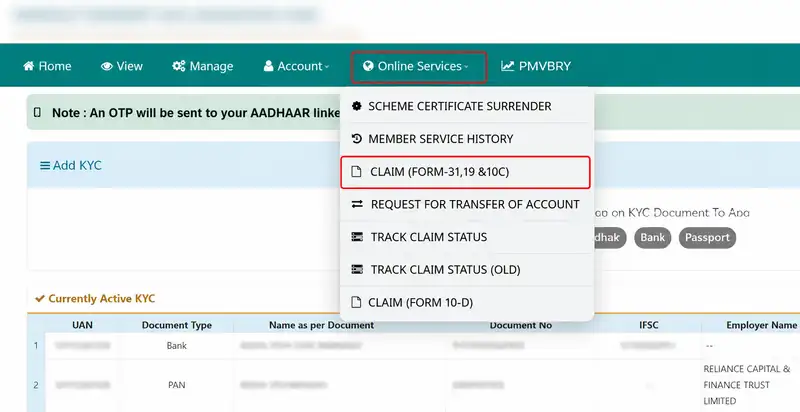
Step 3: Go to Online Services
From the main dashboard, click on Online Services → Claim (Form-31, 19, 10C & 10D)
This section handles all online withdrawal and settlement requests.
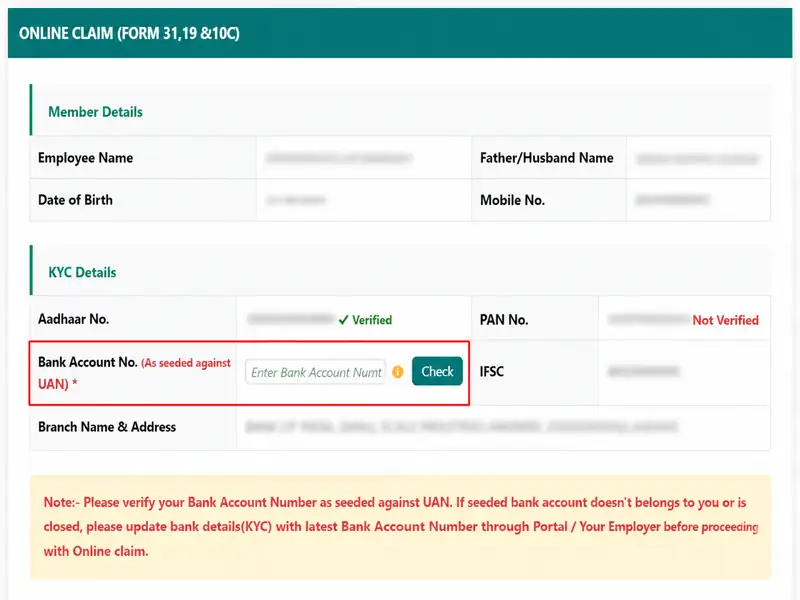
Step 4: Verify Your Bank Account
Your member profile will appear on the screen.
Enter the last four digits of your registered bank account number and click Verify.
Carefully review the details before proceeding.
Note: Under the EPF Scheme, 2026, uploading a cheque leaf or bank passbook copy is no longer required for claims.
Step 5: Accept the Undertaking
A "Certificate of Undertaking" pop-up will appear.
Read the declaration, tick the consent box, and click on Proceed for Online Claim.
This confirms that the information provided by you is accurate.
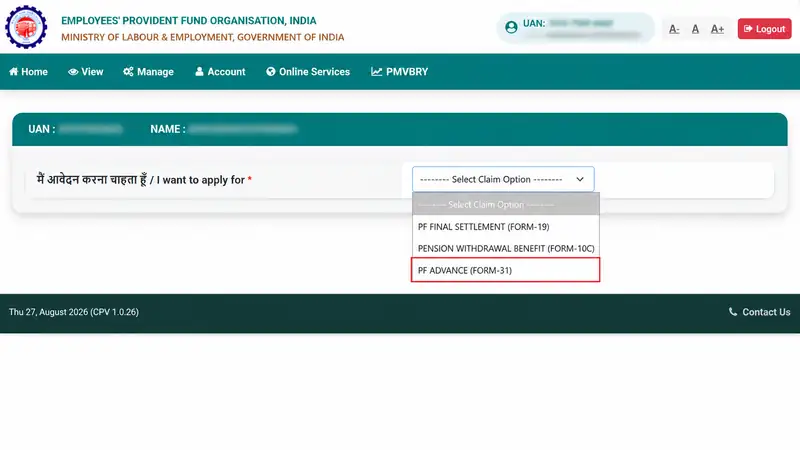
Step 6: Select Form 31
In the drop-down menu titled I Want To Apply For, select: PF Advance (Form 31)
This option is used for partial withdrawals under the eligible categories prescribed by EPFO.
Step 7: Enter Claim Details
Choose the reason for withdrawal from the available list. If you are applying under Special Circumstances, you can proceed without specifying a reason.
Next, fill in:
● Amount you wish to withdraw
● Complete residential address
● Any additional details requested for your selected category
Make sure the amount entered is within the permissible limit for your purpose. Remember that a mandatory 25% of your eligible balance must remain in the account.
Step 8: Authenticate Through Aadhaar OTP
An OTP with an OTP ID will be sent to your Aadhaar-linked mobile number.
Enter the OTP (and not the OTP ID) to verify your identity and submit the application.
Once submitted successfully, you will receive a reference number for tracking your claim.
How Long Does It Take?
Financial emergencies cannot wait. Whether it is a medical expense or an urgent family requirement, timely access to funds is utmost. Fortunately, EPFO has significantly improved its claim processing system.
Under the EPF Scheme, 2026, complete claims must be settled within 20 days of receipt. Any unjustified delay beyond this window attracts penal interest at 12% per annum. For eligible online claims, EPFO now targets a turnaround of just 3 working days.
The exact timeline depends on factors such as:
● Accuracy of KYC details
● Type of withdrawal requested
● Verification requirements
● System workload
Claims with incomplete information may take longer.
Recent automation initiatives have reduced manual intervention for most claims. Auto-settlement now covers a large share of partial claims, with no documentation required in most cases. Eligible auto-settled claims are often processed within a few working hours, and in many cases settled in as little as 24 to 72 hours.
You can also monitor the progress of your application online for peace of mind. Simply log in to the EPFO Unified Member Portal and navigate to: Online Services → Track Claim Status.
The portal displays whether your claim is under process, approved, settled, or rejected. If additional information is required, you may also receive updates through SMS notifications.
Does EPF Advance Have to Be Repaid?
Most assume that since we are receiving money from our EPF account, we will eventually have to pay it back. The answer is simply no. An EPF advance does not require repayment. There are no EMIs, no interest charges and no repayment schedule.
The amount withdrawn permanently leaves your EPF account. In the long-term, this withdrawal reduces your retirement savings.
More importantly, the amount you withdraw stops earning annual EPF interest. Over a long working career, this can make a noticeable difference because of the power of compounding.
For example, withdrawing ₹2 lakh today does not just reduce your balance by ₹2 lakh. It also removes the future interest that amount could have generated over the next 15 or 20 years.
Hence, we recommend using your EPF savings only for genuine needs and not for discretionary spending. If you are considering a PF loan (primarily known as an EPF advance loan), it is worth asking yourself whether another funding source could help preserve your retirement corpus. The 25% minimum balance rule under the new scheme is a built-in reminder to protect that base.
Tax on EPF Advance
Taxation is another area that feels uncertain. The good news is that eligible EPF advance loans are generally tax-friendly when used for approved purposes.
Partial withdrawals made under the prescribed EPFO categories, such as medical treatment, education, marriage, housing, or natural calamities, are generally tax-free. Since you are withdrawing your own accumulated savings under approved conditions, these advances are not treated like regular taxable income.
If you have completed five years of continuous service, withdrawals usually do not attract Tax Deducted at Source (TDS). In certain situations where service conditions are not met, different tax provisions may apply.
It is always advisable to review the latest EPFO and Income Tax rules before making a substantial withdrawal. Understanding these provisions will help you make an informed decision and avoid unnecessary tax complications.
Are You Looking for an EPF Loan?
Your EPF account is designed to provide financial security after your retirement. At the same time, it offers you flexibility when life presents unexpected emergencies.
However, EPFO does not offer a conventional loan. What is most commonly known as an EPF loan is actually a partial withdrawal from your accumulated savings. Unlike bank loans, there are no EMIs or interest payments. But every withdrawal reduces the amount available for your future retirement needs.
Before applying, consider whether the expense is truly essential. Medical emergencies, higher education, housing needs, and family responsibilities are valid reasons to use this facility. Lifestyle purchases and unnecessary spending usually are not.
Using an EPF advance wisely can provide much-needed financial support without creating debt. With the EPF Scheme, 2026 simplifying withdrawals into just three categories and reducing the service requirement to 12 months, accessing your funds is easier than ever — but the responsibility to preserve your retirement corpus is now clearer too. EPF rules, eligibility conditions, and withdrawal limits can sometimes feel confusing, especially when regulations are updated from time to time.
If you need help managing your finances or understanding EPF rules, contact FinRight for expert financial planning and professional guidance. A clear understanding today can help you make better financial decisions tomorrow.
Follow FinRight for more PF updates: Reddit · X · Instagram · LinkedIn · Facebook · YouTube